
Objective
In design thinking, the empathize and define steps are critical to the foundation for a meaningful and impactful design solution. My goal is to deeply understand the people I’m designing for, identifying their needs, behaviors, and motivations. Once I achieve that, I can clearly define the core problems that need solving, ensuring that my design decisions remain user-centered throughout the process.
AI Usage
Leveraging AI during these stages has been extremely helpful and improved the overall work experience. AI is an efficient tool to utilize when dealing with large amounts of information. Within the empathize process, the findings from our interviewers were quite wide because the demographics varied in age, values, and specific needs.
I used AI tools with specific prompts to analyze and extract key insights from user data. For example, I asked AI: “Generate 5 recurring themes in the interviews that focus on user needs. For each theme, provide two direct quotes from the transcripts.” The transcripts provided were interviews my teammates had conducted, from Bailey and Ashlynn.
Additionally, the structured empathy insights generated through AI helped to identify user pain points which will help in developing the app in the later staged of the design thinking process.
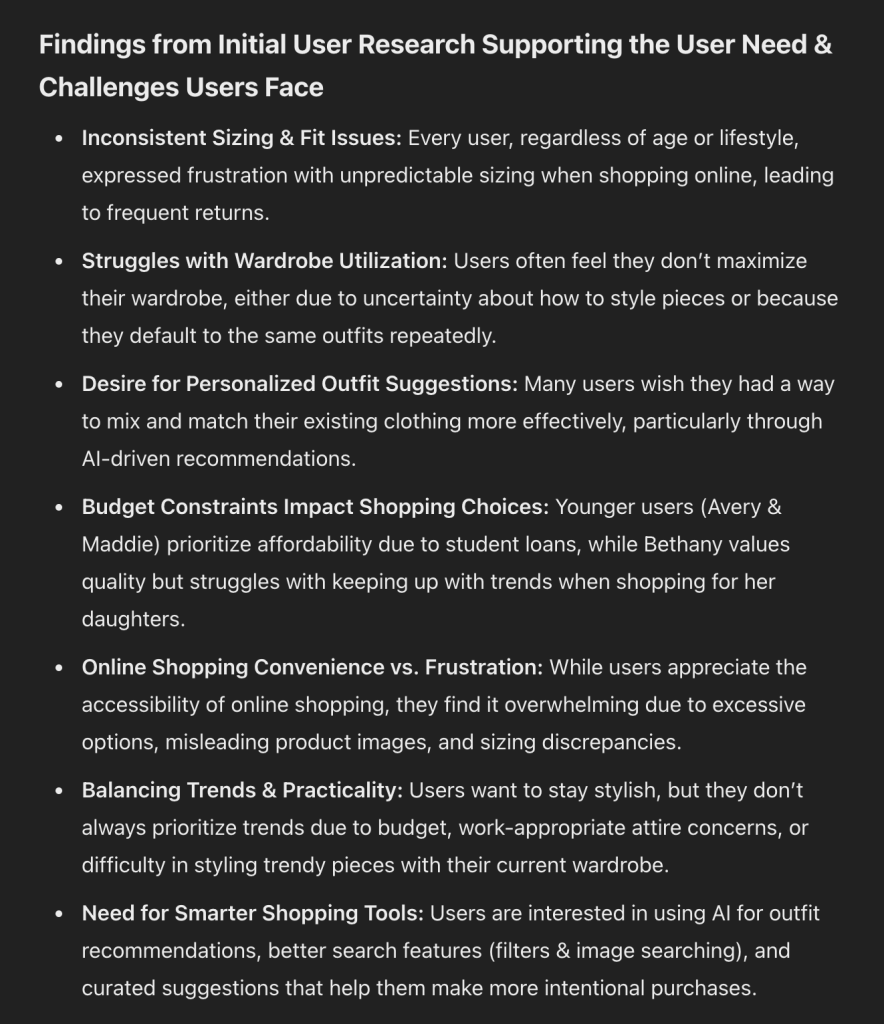
One surprising fact about AI is it’s memory. I experimented with AI’s retention capabilities by uploading multiple transcripts. What I found was that AI can develop a deeper understanding of the general needs our interviewers voiced when conduction user research. In this process, I uploaded every interview conducted, which was a total of 9 people within my team. The direct prompt I gave ChatGPT to find the user needs was: “With the interviews now uploaded, what are the findings from initial user research supporting the user need? Or what challenges do these users face?”
In other areas of the empathize and define process, I used ChatGPT to further organize the results from my interviews. With clear and direct prompts, AI helped me construct user empathy maps using direct quotes from my interview transcripts. I also uploaded my teammates’ interview responses too to develop a persona and journey map.
The persona that ChatGPT created combined all of the interviews, including those who were college students all the way to empty-nester mothers. We realized that the persona produced had too much information about them to truly align with our target audience. She was a 27-year old mother of 2, creative entrepreneur and lifestyle content creator. Although AI’s capabilities to produce such an accomplished persona with major accomplishments, goals, and needs, she was unrealistic to our average target user. This persona could not be used, but helped us to develop personas of our own based off of the goals, needs and frustrations ChatGPT used in their persona.
Challenges
When utilizing AI tools, it was understood that there are still quite a few limitations which must be understood when analyzing the initial user research.
While AI understands language well on a surface level, it may struggle with context-specific or complex human dialogues. AI tools sometimes struggled with context-specific language, especially when users expressed themselves with slang, humor, or cultural references.
I learned that AI lacks creativity and most responses lack depth or innovative solutions. Because AI relies on pre-trained data and often lacks contextual details from user prompts, it may not generate truly novel ideas or concepts that require genuine human intuition, experience, and emotional insight.
AI may not always provide appropriate or accurate responses when the user input is ambiguous or when posed with a complex question. So, it’s important to detect and cross-check AI content with a credible source. Additionally, while AI excelled at identifying patterns, it sometimes overlooked outlier cases that required deeper attention.
Benefits Realized
I believe that AI has positively impacted this process in shortening the time it took to conduct, analyze user research, and formulate our target users into personas. With prompts like those mentioned earlier, I could analyze extensive user insights in hours rather than weeks. This scalability gave me a broader understanding of my user base, leading to more informed problem definitions.
Additionally, the structured empathy insights generated through AI empowered me to develop targeted solutions. The clearly defined problem statements served as a strong foundation for ideation and prototyping, leading to designs that directly addressed user pain points.
Reflection
Reflecting on this experience, I realized that while AI is a powerful ally, it’s not a replacement for human intuition and empathy. The prompts and outputs provided valuable data, but true understanding emerged when I combined these with direct user engagement. Listening to stories, observing real-world interactions, and asking follow-up questions helped me interpret AI findings within the proper context.
Moving forward, I’m excited to continue refining my approach. I plan to explore ways to enhance prompt design, ensuring that AI outputs capture more nuanced insights. Additionally, I’ll experiment with adaptive AI models capable of better handling cultural and linguistic subtleties. By blending AI efficiency with human-centered empathy, I aim to further improve the design thinking process.
